Monday, May 29, 2017

New Hampshire's Renewable Portfolio Standard – Part 3

In previous posts, I provided some introductory information about the Renewable Portfolio Standard (RPS) in NH, as well as specific information about Renewable Energy Credit (REC) trading and pricing. In this post, I take a closer look at the money flows in the RPS program and what it costs NH ratepayers.
                    
But first a quick review. Electricity providers in NH are required to source a certain percentage of their electricity from renewable energy (RE) sources by purchasing RECs generated by RE operations. There are different classes of RE and obligations for each class. RECs are a tradable commodity: their prices depend on supply and demand, which are driven by the various RPS requirements in each state. There is a upper limit on REC prices: as noted in my previous post, the Alternative Compliance Payment (ACP) sets a price cap on what the utilities are required to pay for each REC. If prices of RECs are above the ACP, the utilities are obligated to pay the ACP instead. When there is a shortage of REC in a specific class, their prices quickly rise to the ACP value set for that class; when a surplus occurs, REC prices can drop way below the ACP.

The flows of money (black) and RECs (green) within the RPS program are shown in the figure below. NH electricity suppliers, which include the four electrical utilities (Eversource (PSNH), Liberty, Unitil, and the New Hampshire Electric Cooperative) as well as the competitive electricity suppliers (for example, Constellation and TransCanada Power, among many others), can purchase RECs from NH RE plants or from RE generators in other states, as long as the generators meet the NH class requirements and are registered with the NH Public Utilities Commission (PUC) for that class. Some utilities have entered long-term contracts with RE generators  to buy electricity and the associated RECs directly. An example is the power purchase agreement between Eversource/PSNH and the Berlin Biomass facility that was put into place in 2011. These power purchase agreements have to be approved by the PUC.


When there are insufficient RECs available to meet the various class requirements or if REC prices are higher than the NH ACP, electricity suppliers are obligated to pay the ACP to the PUC. These payments go into the Renewable Energy Fund, which is used to support RE projects in NH. These projects, in turn, generate more NH-based RECs, which can then be purchased by electricity suppliers in NH.


Ultimately, the RPS program is paid for by ratepayers or customers of the various electricity suppliers because all monies paid out by electricity suppliers, either to buy RECs or in ACP payments, are bundled into their overall costs, which then find their way into the rates that the supplier charges its customers or ratepayers.


The money for the RECs is paid directly to the RE generators and is a valuable source of revenue for them. The wholesale price for electricity in NE is typically about $30/MWh, so the additional revenue from RECs, which can range from $10 to $55/MWh, is a very important part of their income. In fact, most RE projects could not survive without the REC income and, for many, it comprises the larger part of their income.

These RECs are, in effect, subsidies for RE generation. It is these subsidies that cause opponents of the RPS a great deal of angst: they view these subsidies as picking winners and losers in the energy market – the winners are subsidized RE generators over fossil-fuel based losers. However, another way to view these subsidies is to consider that they provide stimulus for innovation. We all live our very modern and connected lives due to innovation that has been driven by public policy. Just think of improvements such as microprocessors, vaccines, and the internet, all of which had their origins in government-funded research that was paid by our tax dollars. The RPS is similar: it is a public policy that provides subsidies that allow innovation in the energy field to take place; once technological advancement has proceeded to a certain point, the new technologies can stand on their own merits and compete head-to-head with non-renewable technologies.

One hitch with RECs being a revenue source is that it complicates the wholesale markets for electricity. Revenue from RECs is often much greater than that from the sale of electricity: RE generators want to sell power, regardless of how low electricity rates drop, so that they can generate the associated RECs and earn that income. There are times when RE operations, especially the larger wind operations in New England, will bid into the electricity market at zero or even negative prices, just to earn the REC-based revenue. This can cause market distortions and complicate the economics for non-RE plants, such as nuclear, that are not similarly subsidized.

Let’s turn our attention to those ACP payments. As noted previously, when there are insufficient RECs available to meet the various class requirements or if prices are higher than the ACP, the utilities are obligated to pay the ACP. That money goes into the Renewable Energy Fund, which is used to supplement funding for RE generation by state and local governments, commercial and industrial enterprises, and smaller residential-based projects.

The Sustainable Energy Division of the PUC administers the Renewable Energy Fund and runs two types of programs: a rebate program and a grant program. The rebate program provides direct financial support for commercial, industrial, and residential projects involving the installation of solar photovoltaics (PV), solar hot water, and wood-pellet furnaces. The grant program is a competitive scheme for the installation of RE projects at commercial and industrial operations. There is a rigorous selection process to determine which projects receive funding. The focus of the grant programs changes depending on the particular RE needs. At the moment, the preference is for thermal and small hydropower projects because there are REC shortfalls in these classes and attention is required to get additional facilities up and running to generate more RECs. Funding and disbursement of funds through the rebate and grant programs are reported annually by the PUC. This makes for informative reading if you are interested in these matters.

As can be seen in the figure below, ACP payments fluctuate significantly from year to year depending on a host of issues, including the NH RE requirement (which can ramp up annually), REC prices in other states, eligibility of NH RECs in other states, the number of RE facilities coming online and adding their RECs to market, and operational issues, such as shutdowns at larger RE plants. The ACP payments are typically of the order of $1 to $4 million, but, in some years when there was a shortage of Class 1 RECs, they were very high: in 2013, the total ACPs were $17.5 million; in 2011, they exceeded $19 million. Over the past few years, those very high ACPs have abated as the shortage of Class I RECs has subsided.


I took a look at the most recent report of ACP payments and used the data, plus some calculations, to generate the table below. Based on 2015 retail sales of electricity and the prevailing ACP rates at that time, I calculated that if no RECs were available in any of the classes, the total ACP payable would have been ~$47 million. However, the actual ACP amount paid was only $4.2 million—9% of the maximum payable— which indicates that the electricity suppliers were able to source the difference (91% of their REC needs) from RE generators.


The data also show that, for Class I Thermal and Class IV, more than half of the RE obligation was met by paying the ACP. For the other classes, most RE obligations were met by purchasing RECs, indicating their ready availability, for the most part, in these classes. It is this shortage of Class I Thermal and Class IV RECs that has shifted the focus of the NH PUC Renewable Energy Fund to promoting and supporting thermal and small hydropower projects.

Information on the ACPs is readily available, but, interestingly, that for RECs and what the electricity suppliers pay for them is not. This information is considered confidential and only manifests in the rates that the suppliers charge. For a data geek like me, this is a little disappointing, as I think more transparency would be useful here: we could learn about the origins of the RECs being purchased and see how much is used to support in-state and out-of-state projects. This information would also allow us to determine exactly how much the RPS program costs NH ratepayers. As I noted previously, the extra money paid for RE in the form of RECs or ACPs is funded by rate payers via local electricity rates, but this begs the question: How much does the RPS plan cost NH rate payers? A key piece of information—the costs of the purchased RECs in the different classes—is missing.  

Although this information is not directly available, I made some assumptions, using  historical REC prices, and calculated that, in 2015, the costs of the ACP payments and REC were of the order of $40 million. This is 2.2% of the $1.8 billion that was paid for electricity by NH ratepayers (based on $160/MWh ($0.16/kWh) retail rate and 11 million MWh of electricity). This is in line with data calculated by the Berkeley Lab, which determined that RPS costs for NH were 2.7% in 2012 and rose to 3.2% in 2014.

My calculations were, however, carried out using the 2015 RE requirement of 8.9%.  As we climb up to the 2025 level of 24.8% RE, we can anticipate that costs will increase. Based on moderate electricity use and rate increases, I have calculated that, in 2025, the costs of RPS compliance will be a maximum of 8% of electricity rates, assuming only ACP payments, but are more likely to range from 3% to 5%, depending on the availability and pricing of RECs over the next eight years. 

This post has taken a look at money flows in the RPS program and seen how ratepayers ultimately subsidize RE projects through their electricity suppliers purchasing RECs and paying the ACPs. The program presently adds about 3% to NH electricity rates, but it can be viewed as an important stimulus for innovation of RE sources as we, over time, deplete our resources of fossil fuels.

In the meantime, do your bit to reduce our needs for both renewable and fossil fuel-generated electricity by remembering to turn off the lights when you leave the room.

Mike Mooiman
Franklin Pierce University
mooimanm@franklinpierce.edu

Tuesday, May 16, 2017

New Hampshire's Renewable Portfolio Standard – Part 2

In my introductory post on the Renewable Portfolio Standard (RPS) in NH, I provided some basic information on RPS programs, how they work, and what renewable energy credits (RECs) are. In this post, I take a deeper look into the buying and selling of RECs and their pricing.

In Part 1, I noted that there were four classes of RECs in NH (see the figure below). Classes I and II are for the newer RE technologies and those operations that have come on-line since 2006. Class II is dedicated to solar power alone. Classes III and IV are for older biomass and smaller hydro operations that were established before the end of 2005. NH is unique in that it is the first state to have developed a sub-class and specifications for thermal RECs. These RECs are distinctive because they don’t involve the generation of electricity, but instead involve electricity savings via renewable energy sources such as the installation of a solar hot water heater, geothermal system or a wood fired boiler.


Carve outs such as those for solar and thermal are useful as they create specific requirements for a particular type of renewable energy and prevents a flood of RECs from another source, such as a large wind or biomass project or even out of state generation, from driving down REC prices in these special classes

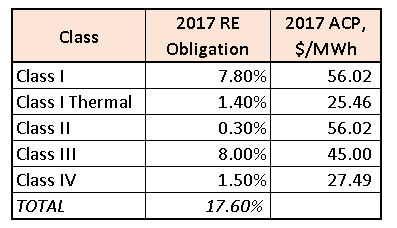
In 2017, the total NH requirement for renewable energy is 17.60% of total electricity generation. The amount for each class, along with their Alternative Compliance Payment (ACP), is shown in the table below. As I noted in my previous post, the ACP sets an upper limit – a price cap – on what the utilities are required to pay for each REC. If prices of RECs are above the ACP, the utilities are obligated to pay the ACP instead. When there is a shortage of REC in a specific class, their prices quickly rise up to the ACP value set for that class; when a surplus occurs, REC prices can drop way below the ACP.


The allocation between the different classes is interesting. The NH program, similar to those in many other states, has a heavy weighting to newer renewable energy generation operations in Class I, but there is also (naturally, for a tree-covered state) a hefty weighing to Class III to support and subsidize the pre-2016 biomass electric generators in NH. The support for solar via Class II, is, compared to some other states, like Massachusetts, minimal.

When the RPS plan was first implemented in 2008, a steady ramp-up in the amount of renewable energy was anticipated, from 4% in 2008 to 24.8% in 2025. Instead, there have been some important modifications to the requirements of the various classes. From 2012 to 2016, the amount of renewable energy from Class III was significantly curtailed to cope with the shortage of Class III RECs. The reasoning was that a shortage of available Class III RECs would drive the utilities to pay the ACP instead and, with the large requirement for Class III and the high ACP payments, the costs to ratepayers would be too high.

The figure below shows how the amounts for the different classes have changed over time. Generally, the heavy weightings of Class I and Class III are clear and the big dip created by the reduction in the Class III obligation from 2012 to 2016 is obvious. In 2017, the Class III requirement zooms up from 0.5 to 8% again and the total renewable energy obligations are back on track to meet the 2025 goal.

Different states have different RPS goals, classes, and requirements for different types of renewable energy. For example, Maine promotes biomass and has a high biomass requirement and Vermont includes large-scale hydro. Each state has different ACP caps for their different classes. Complications arise as RECs generated in one state can qualify to meet another state’s REC requirements. Moreover, RECs qualifying in one state for a specific class can qualify as another class in another state.   This creates a New England market for RECs but also a complicated mess due to the inconsistency in intra-state, inter-class transactions that can occur.  According to ISO-NE the “regional REC market is not a true regional market due to the lack of uniformity and consistent price caps”.

The result is that high ACPs, and thus high REC prices, in one state can draw in RECs from a neighboring state, thereby raising prices in the REC export state. For example, RECs from the older NH biomass operations, i.e., NH Class III, qualify as Class I in Connecticut (CT), so if REC prices in CT are high, NH Class III generators will sell their REC into the CT market instead of NH. For a number of years, CT had an enormous Class I REC requirement, which drove regional REC prices high – close to $55 (the CT ACP level). As a result, CT became a REC black hole, sucking in RECs from other New England states, including NH Class III generated RECs. This drove up regional Class I REC prices, as well as those for the NH Class III RECs. This situation created the shortage of NH Class III RECs referred to earlier and prompted the NH Public Utilities Commission to change the Class III requirements over the 2012–2016 period. 

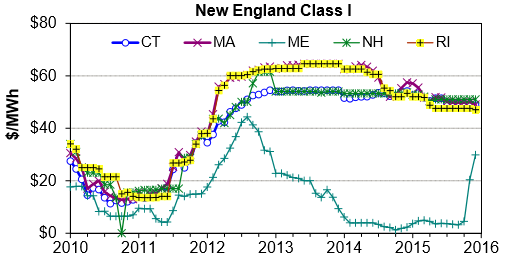
As shown in the chart below, Class I REC prices were, for a number of years, right around $55, which is the CT and NH ACP value. Massachusetts and Rhode Island prices were higher for a while, reflecting their higher ACPs. Biomass from Maine did not qualify in other states and the large volume of available biomass kept Maine Class I prices low. This chart only shows information until the end of 2015.


Source: Berkeley Lab

In the last year, we have seen big changes in REC market pricing. The CT REC market has recently moderated, due to changes in CT Class I specifications as well as a lot of renewable energy supply coming online. As a result, CT has received a flood of Class I RECs, and NE Class I prices have dropped to about $16, as can be seen in the chart below.


Source: Karbone

It should be noted that REC banking is permitted, which allows electricity suppliers to take advantage of low prices to purchase RECs for use in subsequent years. REC banking rules differ from state to state: for NH, 70% of RECs used to meet a specific RE obligation must be from current year of production, but unused RECs can be used for a further two years.

This post has provided some information about the changing REC obligations in New Hampshire especially those in Class III, and current REC pricing. This will provide a good starting point for future posts, in which I will be taking a closer look at money flows in the RPS program, as well as the implications associated with that big ramp up in Class III requirements that NH is facing in 2017. 

Until my next post, do your bit to reduce our needs for electricity and RECs by remembering to turn off the lights when you leave the room. 

Mike Mooiman
Franklin Pierce University
mooimanm@franklinpierce.edu


Wednesday, May 10, 2017

New Hampshire’s Renewable Portfolio Standard – Part 1

Just like the regular attempts to repeal New Hampshire’s participation in the Regional Greenhouse Gas Initiative, there are perennial attacks on the NH Renewable Portfolio Standard. It is important to know about these programs so that the associated debates can be fact-based. In my next couple of posts, I have assembled information on the Renewable Portfolio Standard and how it impacts NH. This post presents some general information; in follow up posts, I will dig into the details, money flows, and costs of these programs.

A Renewable Portfolio Standard (RPS) is a mandate by a government, local or state, that requires electrical utilities to source a certain amount of their electricity supply from renewable energy sources. The intent of an RPS is to promote and subsidize the use of renewable energy sources such as those produced by natural processes such as solar, wind, hydro, ocean, biomass, or geothermal sources. The use of renewable energy decreases the burning of fossil fuels, which, in turn, reduces emissions of greenhouse gases and other associated pollutants. In the process, it improves public health, uses local natural resources, and creates local business opportunities and jobs.

Most states already have an RPS in place: by April 2017, 29 states had a mandated RPS program, eight had renewable energy goals, and only 13 did not have any renewable energy requirements. The map below shows the RPS status across the US. The site from which I copied this information, the National Conference of State Legislatures, has a very useful interactive map that provides specific information for each state. Each state has different regulations and requirements for their RPS programs. The most ambitious is Hawaii, which mandates that 100% of their energy needs will be generated by renewable sources by 2045.
 Source:NCSL


New Hampshire’s RPS was implemented in 2007. Its main components are as follows:
  • By 2025, 24.8% of electricity sold in NH must come from renewable energy sources;
  • Four classes of renewable energy sources are considered;
  • Sourcing of renewable energy by electricity suppliers is demonstrated by the purchase of Renewable Energy Credits (RECs) in each of the classes;
  • An alternative compliance payment has been established for each class to provide a cost cap on  REC prices;
  • The total amount of renewable energy increases each year: from 4% in 2008 to 24.8% in 2025 (although adjustments in the total amount and amounts in each class can be —and have been— made to accommodate market conditions).
The four NH classes of renewable energy are shown in the figure below. Classes I and II refer to newer renewable energy technologies and operations that have been commissioned since 2006. Class II is a special carve out for solar power. Classes III and IV are for the older biomass and smaller hydro operations that were established before the end of 2005.


The implementation of an RPS occurs through the generation, sale, and purchase of renewable energy credits, RECs.  A REC is a digital certification that the particular generator has produced 1 megawatt hour (MWh) of electricity from a renewable energy source, such as those listed above. Each megawatt of renewable electricity gets assigned a unique certificate number and a date of production and it then becomes a tradable instrument - a REC that can be bought and sold like a stock or bond. They give renewable generators two products to sell: the actual electricity that they produce and the RECs. The RECs therefore provide an extra revenue stream – in effect, a subsidy – for renewable energy generation.

RECs are issued and tracked by the New England Power Pool Generation Information System (NEPOOL GIS) and there is a regional market for these certificates. The sellers are generators of renewable energy and the buyers are usually electricity suppliers, like Eversource, that are looking to comply with the RPS program. Like any other market, there are supply and demand aspects and, should there be a shortage due to insufficient renewable generation, REC prices go up, signaling to the market that more RE sources are required. It is important to note that the price of RECs has little correlation with the price of electricity: REC prices are set by supply and demand in the markets where they are traded. The supply is set by the amount of renewable energy that is generated and the demand by the amount of renewable energy the utilities are required to source, which, in turn, is dictated by different RPS regulations in each state.

To comply with the RPS, the NH electricity suppliers, utilities (such as Eversource), and competitive suppliers (such as Constellation) are required to purchase a sufficient number of RECs to match their renewable energy obligations in each class for any particular year. This demonstrates that the required portion of their supplied electricity is generated by renewable energy sources. NH is a deregulated state, so utilities are not allowed to own power plants, even renewable ones: they must therefore meet their renewable energy requirement by purchasing RECs that are generated by non-affiliated renewable energy generators.

REC prices can fluctuate with changing demand and supply; in the case of short supply and/or high demand, prices can escalate so a price-cap mechanism has been built into the program. This is known as the Alternative Compliance Payment (ACP). It sets an upper limit on what the utilities are required to pay for each REC. If prices of RECs are above the ACP, the utilities are obligated to pay the ACP instead. A table of recent ACP prices published by the NH Public Utilities Commission is provided below, showing a separate ACP for each class of renewable energy. Adjustments in the ACP are made from year to year, depending on the rate of inflation and legislative modifications to the RPS program.


Before wrapping up this introductory post, I thought it would be useful to get a sense of what is involved in producing 1 MWh of electricity from a renewable energy source, which is the requirement to produce a single REC. One megawatt hour (MWh) is equivalent to 1000 kilowatt hours (kWh), which represents approximately six weeks of electricity use in an average NH home (assuming a monthly use of 600 kWh). This is also the approximate amount of electricity that a three-panel solar array, rated at 0.75 kW, would produce in one year. Most residential solar systems are larger, ranging from 2 to 5 kW, and produce ~2 to 7 MWh/year, or 2 to 7 RECs per year. At the other end of the scale, the Lempster wind operation,  which has 24 wind turbines each rated at 2 MW, would generate ~105,000 RECs per year (assuming a 25% capacity factor).

Having covered some introductory information about the RPS program, such as the different classes, RECs, and the ACP, I will turn my attention in my next posts to the renewable energy quotas for each class, REC pricing, and the money flow in the RPS program. Until then, reduce your need for both fossil and renewable energy by turning off the lights when you leave the room.

Mike Mooiman
Franklin Pierce University
mooimanm@franklinpierce.edu

Tuesday, May 2, 2017

The Regional Greenhouse Initiative - Part 3

In Part 1 and Part 2 of my posts on the Regional Greenhouse Gas Initiative (RGGI), I reviewed the money flows in the program and presented data on the remarkable decrease in carbon dioxide (CO2) emissions that we have seen since its implementation. In this post, I present some of the pros and cons of the RGGI program and some evidence that supports the assertion that RGGI has been responsible, in large part, for the decrease in regional CO2 emissions.

Based on my research, the RGGI program seems to have some positive attributes, as well as some downsides. The advantages can be listed as follows:

  • Since implementation of the program, CO2 emissions have declined significantly. See figure below.
  • The program puts a price on carbon in the electricity markets and provides incentives for us and the market to make economic choices regarding our electricity generation. Carbon pricing should lead the market to prefer lower carbon sources and thus provide economic support for low-emission sources, such as renewables.
  • It is a market-based program, which provides generators with choices. They are required to participate but they can choose to purchase allowances or make investments in lower-carbon technologies to ensure that their carbon generation falls within their share of the particular cap specified at the time.
  • The allowances generate a pool of money that is shared between participating states. This is returned to ratepayers in the form of direct rebates and used to fund energy-efficiency (EE) programs. The EE portion creates a virtuous cycle, in which carbon prices fund EE measures, which then lead to further reductions in energy use and carbon dioxide emissions.


One of the biggest criticisms leveled at the RGGI program is that the regional reductions in CO2 emissions, noted in Part 2 of this series, are not attributable to more efficient plant operations induced by the RGGI program; rather, they are due to less in-state generation, conversion to natural gas which was already underway, and a slower post-recession economy.

A recent economic study examined this issue directly and reviewed reasons behind the decline in emissions. The authors of the study highlighted the following facts:

Carbon dioxide emissions from the RGGI states have declined, but the decrease is due to a number of factors, including:
  1. The 2008/2009 Great Recession: with the economic slowdown, came reduced energy demand, less generation, and therefore fewer emissions;
  2. Low natural gas prices, created by increased supply from the implementation of fracking technology: natural gas produces less CO2 emissions per unit of generated electricity when compared with coal;
  3. State programs promoting EE project implementation or renewable energy generation, such as renewable portfolio standards;
  4. The RGGI program, which puts a price on carbon dioxide emissions.

The authors then carried out a complicated economic analysis to disentangle the effect of each factor on regional CO2 emissions. What they concluded is the following:
  • Without the impact of all the factors noted above, CO2 emissions would have been 60% higher;
  •  The bulk of decrease in emissions is, in fact, due to the RGGI program;
  • Substitution by natural gas was an important factor, but less so than the RGGI impact;
  • The impact of the recession on CO2 emissions was minor;
  • Some of the benefits of the RGGI program are undone by neighboring non-RGGI states that sell electricity into the regional power pools. Their coal-fired generation without the RGGI adder then becomes competitive and so more electricity is generated from their high-CO2-emissions plants.

This provides good evidence to support the direct impact of the RGGI program, but is just a single economic study. I look forward to seeing others.

Other criticisms of the RGGI program include the following:
  • It increases electricity costs to consumers in a region that already has high electricity rates.
  • The implications of RGGI are only now starting to kick in. After recent implementation of the Adjusted Cap, CO2 allowance prices have increased significantly and this could further impact electricity rates going forward.
  • RGGI sets up unfair competition by neighboring states that don’t have these requirements. Their costs of generation do not include RGGI costs so their electricity is cheaper and they can sell into the RGGI markets with a built-in cost advantage.
  • There are a lot of free riders – RGGI ratepayers lead by example by paying for reduced CO2 emissions, but residents of non-RGGI states benefit from the cleaner air.
  •  RGGI funds making their way to the states have been raided for other purposes, such as balancing state budgets, and are not always used to fund EE and renewable energy projects, which was the original intention of the program.
  • Carbon pricing through the RGGI program is unfair to electricity ratepayers because other regional CO2 emissions, such as those from transportation and heating, are not subject to carbon pricing.  

The argument that the RGGI program does increase the cost of electricity is valid, but it is important to put this into context. Let’s examine what the present carbon price means for individual ratepayers in terms of electricity rates. A review of RGGI state data from the Energy Information Agency (EIA) indicated the RGGI states, on average, emit 0.34 tons CO2 per MWh of generated electricity. We can then calculate that a CO2 price of $5/ton leads to an incremental cost of $1.70/MWh or 0.17 cent/kWh. If you use 600 kWh per month, this represents $1.02 in incremental costs on your bill. However, this calculation does not take into account that House Bill 1490 legislation mandated that only the first $1/ton CO2 from the CO2 emissions allowance auction proceeds could be used towards EE: anything beyond that has to be rebated directly to electricity ratepayers. As a result, most NH RGGI funds now go to direct bill rebates, so (assuming a $5/ton carbon price) ratepayers get about 80% of the RGGI costs back. If we back out the rebate, the cost to ratepayers is of the order of $0.20/month or 0.034 cents/kWh for 600 kWh/month electricity usage. This is in line with the rate impact calculations presented in the recent annual report on the RGGI program in NH. As you can see, there is an impact of RGGI on electricity rates, but the total amount paid by an individual ratepayer is tiny.

As I wrap up this three-part series on RGGI, it is clear that it is a complicated—but important—program. There is evidence that it appears to be having significant impact on regional carbon emissions, but, at the same time, it does impacts regional electricity prices; however, after including bill rebates, the utility bill impact to the average NH rate payer is tiny. A few years ago RGGI was viewed as a model program for the rest of the country and, if implementation of the EPA’s Clean Power Program had proceeded, participating states would have a considerable head start. Unfortunately, it looks like RGGI will remain a regional initiative only because there is no support from the Trump Administration for clean power or carbon pricing mechanisms. The most important development in the RGGI world is the review of the program that is currently underway, as this will set the tone for the RGGI program, carbon prices, and regional electricity rates going forward.

Until my next post, do your bit to reduce carbon emissions by remembering to turn off the lights when you leave the room.


Mike Mooiman
Franklin Pierce University
mooimanm@franklinpierce.edu


Monday, April 24, 2017

The Regional Greenhouse Initiative - Part 2

In Part 1 of this series of posts on the Regional Greenhouse Gas Initiative (RGGI), I reviewed how money flows from ratepayers, to the utility companies, to the electricity generators, to the participating states, and then back to the ratepayers as direct bill rebates or to investments in energy-efficiency (EE) initiatives. With an understanding of what happens to our ratepayer dollars in this program, let’s now take a look at the actual allowance caps and what has happened to regional carbon dioxide (CO2)  emissions since the program was implemented in 2008.

The chart below presents data on the emission caps, the actual CO2 emissions from power plants in the RGGI states, as well as the average prices achieved in the RGGI auctions of emissions allowances. The first regional cap (shown in blue) was implemented in 2009. For the first few years of the program, actual emissions (shown in green), which were already trending downward due to extensive use of natural gas generation, were substantially lower than the cap. This made compliance easy and resulted in lower prices for the allowances (as shown on the bar graph). In 2014, after a review of the program, there was a big downward adjustment in the cap and the compliance margin narrowed considerably.


The intent of the shrinking cap in cap-and-trade program is to issue fewer emission allowances every year. In theory, this should increase allowance prices and make fossil fuel operations with high CO2 emissions, such as coal plants, the more expensive producers in the electricity marketplace. High generation prices would force these operations out of business or drive them to make changes to reduce carbon emissions. However, during the first period of the RGGI program from 2008 to 2014, when the cap was so much higher than the actual emissions, allowances prices were low (of the order of $2 to $3/ton CO2) and RGGI participants were able to buy and bank over 120 tons of emissions allowances. This is more than one year’s worth of allowances.

The problem with these banked allowances is that they can be used at any time, so their availability puts downward pressure on the prices at auction. To take this large volume of banked credits into account and flush them out of the system, the RGGI program then implemented a further downward adjustment in the cap in 2014 – the Adjusted Cap (shown in red). With this change, actual emissions are now well above the Adjusted Cap and it is anticipated that this will increase the price for emissions allowances and draw those banked credits into the market. With these changes, allowance prices did indeed rise in 2014 and 2015; however, since 2016, when the Supreme Court suspended implementation of the Clean Power Plan and Donald Trump, with his antagonistic view of regulation,  was elected President, allowance prices have again fallen. There is also an interim review of the RGGI program underway, so participants are awaiting its outcomes and indications as to what the caps will be after 2020. The successful continuation of the RGGI program, the magnitude of the future caps, and the utilization of the banked allowances should have a significant impact on allowance prices going forward.

Carbon emissions from power plants in NH have also fallen, as is evident from the figure below, which also shows the NH-specific RGGI caps and adjusted caps.  Emissions from NH operations dropped by 67% since 2005, compared with a 56% decrease for all the RGGI states. A great deal of this improvement was driven by reduced in-state coal-fired generation. Even with the adjustment, NH CO2 emissions were below the cap in 2016.  In the RGGI states, there are over 160 carbon-emitting generating operations that need to comply with the program, but, of the 31 generating plants in NH, only five  (Merrimack, Schiller, Newington, Granite Ridge Energy, and Essential Power Newington Energy LLC) are affected.  


In these first looks at the RGGI program, I have taken a rather simple view of the program by considering where the money flows, the cap values, and the actual CO2 emissions. There are many interesting aspects of the program that I have not covered. These include offsets, where generators can invest in projects such as landfill methane gas capture, re-forestation, EE investments in the building sector, etc., to offset their carbon emissions. There is also a two-sided cost containment reserve – a reserve pricing mechanism that provides a floor price for carbon and a high-price trigger that allows sale of banked allowances to provide a lid on prices: in 2017, the minimum carbon price is $2.15/ton CO2 and the high-price trigger is $10/ton CO2. These might be good topics for future posts.

We can conclude that, since the start of the RGGI program, CO2 emissions have decreased significantly and have been way below the established caps. This has resulted in low allowance prices and the banking of a large volume of allowances by generators that can be used in the future. This has perpetuated low emissions pricing and, to compensate, the RGGI program recently implemented an even lower Adjusted Cap, which is hoped will draw banked allowances into the market and result in higher emissions prices in the future. The RGGI program has been in place since 2008 and a lot has been learned along the way. It was viewed as a model program for other regions when the Obama Administration’s Clean Power Plan (CPP) was in play. With that plan on hold for the foreseeable future, the future of the RGGI program remains a regional matter and the program review that is presently underway is crucial to its successful continuation beyond 2020. 

In my next post, I will take a look at the reasons behind that dramatic decrease in CO2 emissions over the past few years and the role of RGGI in this. Until then, do your part to keep emissions low by turning off the lights when you leave the room.

Mike Mooiman

Franklin Pierce University
mooimanm@franklinpierce.edu

Saturday, April 15, 2017

The Regional Greenhouse Initiative - Part 1

Like the snow in winter, there are annual legislative proposals we can count on: one of them is legislative action to pull New Hampshire out of the Regional Greenhouse Gas Initiative (RGGI). This has become a perennial component of the energy debate in NH, so I thought it would be useful to get a better understanding of this initiative and an appreciation of its pros and cons.

Understanding electricity rates in NH is a complicated business. There are transmission and distribution charges, systems benefit charges (some of which go into energy efficiency), and stranded costs. On top of these is the actual cost of electricity, which includes the cost of generation plus costs associated with RGGI and the NH renewable portfolio standard.

Let’s start by learning what RGGI is. The Regional Greenhouse Gas Initiative is a multistate carbon cap-and-trade plan that started in 2009. Nine states (Vermont, Massachusetts, Maine, Rhode Island, Connecticut, New York, Maryland, Delaware and New Hampshire) have agreed to cap regional emissions of carbon dioxide (CO2) from their power plants. (New Jersey was a member for a few years but withdrew in 2012.) Allowances for each ton of CO2 emissions, equal to the cap value, are issued by the RGGI program. Power generators are then required to purchase emissions allowances equivalent to the value of their own CO2 emissions in an auction market.  

A key feature of the program is that the cap ratchets down every year and fewer emission allowances become available.  Power generators adapt by reducing emissions through more efficient operations or equipment, by using renewable energy generation (such as solar or wind), or, if these alternatives are not possible, by purchasing CO2 emission allowances from the available pool. Over time, the reduction in emission allowance availability should make them more expensive and drive generation toward lower-carbon-emitting generation resources.

The appeal of this approach is that it uses market mechanisms—instead of regulatory command and control actions or carbon taxes—to reduce CO2 emissions. Generators make their own decisions as to what is best for their business and they can delay big investment decisions by simply purchasing emissions credits. Moreover, to meet the shrinking cap, the market creates incentives to find better and cheaper ways to reduce emissions through the use of technology. In the process, we and the planet benefit from reduced emissions. It is important to realize that this is not a zero-sum game. This mechanism puts a price on carbon and we, as ratepayers, fund the program; as the cap ratchets down every year, the cost of carbon will go up.

Cap-and-trade programs are not new. One of the most successful focused on acid rain. To deal with this problem, a national cap-and-trade system for sulfur dioxide (SO2) emissions was established. The market went to work, resulting in a 69% drop in SO2 emissions from 2005 to 2014.  The European Union also has a carbon emissions trading program, as do California and Quebec.

In the RGGI program, the money raised in the carbon allowance auction is returned to the participating states, so, because I am always interested in the money flow in these programs, I prepared the figure below to aid my understanding.

Let’s start on the left side of the diagram with the generators. A power plant generates electricity and is required to purchase the corresponding carbon allowance equivalent to their emissions through the RGGI auctions. The cost of the allowance becomes part of the cost of electricity costs that the generator charges to the utilities. The utilities then turn around and charge the ratepayers for the costs of electricity, which include the embedded RGGI costs (red arrows). As a result, there is a money flow from the ratepayers to the utilities to the generators to the RGGI auction pool (blue arrows). Proceeds from the RGGI auctions are returned to the states, where some of the money returns directly to ratepayers in the form of annual RGGI rebates or is used to fund state energy-efficiency (EE) programs. Within this money flow, good things happen, as shown by the green arrows: local jobs in the EE marketplace are created, appliances and materials are purchased from NH businesses, energy demand is reduced (which should help reduce electrical rates increases in the future), and CO2 emissions from electricity generation are reduced.   


From 2009 to 2016, $2.63 billion of RGGI auction funds were raised, of which NH received $116 million in proceeds. Participating states make their own choices as to how the funds are allocated: these are typically directed to EE, renewable and clean energy, greenhouse gas abatement, and direct bill-assistance programs. But, for some, RGGI funds represent a tempting target and various participating states have, at different times, redirected those funds to other purposes: even NH, in 2010, directed $3.1 million in RGGI proceeds to the NH general fund to meet budget shortfalls.

During the early years of the program, most of the RGGI funds returned to NH were used for EE programs. In 2012, however, House Bill 1490 legislation mandated that only the first $1/ton CO2 from the  CO2 emissions allowance auction proceeds could be used towards EE: anything beyond that has to be rebated directly to electricity ratepayers. This significantly reduced funds available for EE investments and these remaining funds were then allocated through NH’s Core EE program.  This is important because recent auction prices for carbon emissions have been of the order of $3 to $5/ton, so only a small fraction of RGGI proceeds are directed to EE, with the larger portion now going to direct bill rebates. There have been other tweaks to program, including a required allocation of 15% of the funds to low-income weatherization programs and $2 million set aside for municipal EE programs.

The RGGI program reports how the participating states use their funds in a series of annual reports, but these are not particularly current: the most recently available only includes data to 2014. To provide updated results, I used the RGGI auction results for 2015 and 2016, factored in the administration and RGGI Inc. costs, and split the remaining funds, taking in account that only the first $1/ton CO2 of the auction proceeds are allocated to EE. The rest goes to direct bill rebates. My estimates for the cumulative allocation of the funds since inception of the program are presented below. This indicates that, so far, the funds have been split evenly between EE and bill rebates. With time and higher CO2 allowance prices, however, we will see direct bill rebates becoming a larger part of the allocation pie in the future. 


In conclusion, the RGGI program has raised a great deal of money from ratepayers through higher electricity rates since 2009 and NH has received ~$115 million of the RGGI proceeds. To date, about half this money has been returned to rate payers and the other half has gone to EE initiatives. The EE portion is particularly important as it creates a virtuous circle of sales of local goods and services, the creation of local jobs, reduced energy usage, and lower carbon dioxide emissions.

With most of the NH RGGI funds now going to direct bill rebates, we have created this odd construct in which ratepayers pay RGGI costs monthly through their electricity bills and then once a year they get a rebate for most of those cumulated RGGI costs. In this money flow, some of the funds make their way to important and beneficial EE projects, but there is also a portion (~5%) that goes to supporting the administration and overheads associated with the RGGI program.

Even though this money flow might appear convoluted and inefficient, we should not lose sight that the objective of the RGGI program is to put a carbon price on electricity generation, to use market mechanisms to create the incentives to reduce carbon emissions, and to direct some money to beneficial EE projects.  

Until my next post, in which I will look at how successful the RGGI program has been in reducing CO2 emissions, do your bit to reduce carbon emissions by remembering to turn off the lights when you leave the room.

Mike Mooiman

Franklin Pierce University
mooimanm@franklinpierce.edu