Monday, November 4, 2013

Options* - PSNH Generating Assets – The Choices

With the advent of retail choice for electricity supply in New Hampshire, there has been a great deal of migration away from PSNH. Fixed costs associated with their generating operations are high and, with a smaller customer base to spread them over, their electricity supply prices have increased. This vicious spiral of higher prices causing more migration, followed by higher prices for the remaining PSNH customers is plainly unsustainable. As a result, there has been a great deal of discussion by regulators and legislators in New Hampshire about this problem.

The NH Public Utilities Commission released a staff report dealing with this matter in June. The Legislative Oversight Committee on Electric Utility Restructuring has been meeting since the summer and much of their discussion and debate revolves around whether the State should complete the process of electricity deregulation and compel PSNH to divest themselves of their generating assets. It is anticipated by some that this would reduce PSNH rates and allow them to be more competitive. In my last blog, "Should I Stay or Should I Go?", I laid out the arguments for and against divestiture. In this post, I examine the options that are available with respect to the PSNH power plants.

 
But before we look at the options, allow me to share with you the story of the Brayton Point coal-fired power plant which is located very close to Fall River in Southeast Massachusetts. This is a large coal-burning plant with a generating capacity of 1535 MW from four turbines. It is situated on the water's edge at the top of Mount Hope Bay and is visible when crossing over the Braga Bridge on I-195 into the Fall River area. It is now even more noticeable due to the recent erection of two enormous 500 ft tall cooling towers.

 
Photo Source: Dominion

The plant had for many years been owned by Pacific Gas and Electric, a California utility. In 2005, the Brayton Point power plant and the coal-burning plant on Salem harbor in Massachusetts were sold to Dominion Resources. In order to continue to operate the power plant, Dominion was required to install the two cooling towers shown in the photo above at a cost of $500 million. The cooling towers were necessary to comply with an EPA edict to reduce the amount of single-pass cooling water from the operations. Prior to the cooling towers, the plant was cooled by simply pumping water from Mount Hope Bay through the power plant to get rid of the waste heat and then returning the water right back into the bay. In the process, water treatment chemicals were added, any aquatic life was shredded in the pass through the cooling operations, and a large volume of warm water was discharged which impacted the marine ecosystem in the bay.
 
After investing over $1 billion dollars into the operations to ensure environmental compliance, in March this year, Dominion Resources sold the Brayton Point power plant to a private equity group, Energy Capital Partners, along with one gas-fired and one coal-fired plant in Illinois. After owning the plant for just six months, in October this year, Energy Capital Partners announced that they were shutting down the plant in 2017. Their original plan had been to convert the plant to a gas-fired operation but they said that low electricity prices, reduced capacity payments (created by a surplus of natural gas prices), large investments required to meet environmental regulations, and the costs to operate and maintain an older plant did not warrant keeping the operations running. I tend to be somewhat skeptical that they only figured this out after their purchase. These private equity organizations do a great deal of due diligence and financial analysis beforehand and they hire the best experts to advise them. I think it more likely that they took into account beforehand that they might need to shutter the plant and the Brayton Point operation just became the ugly bruised apple in the package that they discarded as soon as it was prudent.
 
So what lessons do we draw from Brayton Point? Consider the following:
  • Old aging coal-fired power plants in New England have little, if any, value in a sale in the present low-priced natural gas period.
  • This does not bode well for future sales of coal-fired power plants in New England: if the plants are sold it is likely going to be for pennies on the dollar, if they are even sold at all.
  • Enormous investments are necessary to ensure environmental compliance of these operations and, even after these investments, there is no assurance that these costs can be recovered. Dominion Resource squandered an enormous amount of shareholder value in environmental compliance and on those huge cooling towers which, just one year after their construction, were of little value to the new owners.
  • Converting coal-fired operations to natural gas-fired operation does not seem to be an obvious solution, even when you have two new cooling towers at your disposal.
  • Sometimes retiring an old coal-fired power plant is the best solution.

With the background of that sobering story in our mind, let us now return to PSNH and consider the options available as NH legislators, regulators and PSNH scuffle over the fate of PSNH's generating assets.
 
The options* are:
  1. Do nothing.
  2. Spread costs associated with generating assets over larger number of customers.
  3. Move the generating assets into a separate company and become a competitive electricity supplier.
  4. Sell generating assets.  
Let's explore each of these.
 
Option 1: Do Nothing
 
Well, this is pretty much what has been happening since 2001 when the process of deregulation and the sale of PSNH generating assets were halted by the NH legislature. But, as we know, retail choice for electricity supply has resulted in the exodus of a large number of customers to competitive suppliers. In 2012, only 26% of the electricity supplied to PSNH customers was generated by PSNH itself. The rest came from competitive suppliers and from PSNH purchases of electricity from independent power producers and the open market. PSNH rates are higher because it is distributing fixed costs over a dwindling customer base. This has been referred to by many as the "PSNH death spiral" and is a well known financial concern in businesses with high fixed costs. The cost components for PSNH-supplied electricity in 2012 are shown in the pie chart below. Almost 50% of the costs - operations, maintenance, taxes, depreciation and return on assets - are fixed in nature, with the rest being more variable (but likely with some fixed cost components).
 Data Source: NHPUC: DE 13-108

When challenged about the death spiral concerns, the PSNH response has been that this problem has been caused by poor policy and the fact that generation expenses can only be recovered from PSNH electricity supply customers and not from all PSNH's distribution customers. At the time this policy was formulated, it probably seemed reasonable and prudent that PSNH electricity service customers should bear the cost of PSNH's generating operations. But, in hindsight, I think this migration and climbing cost issue might have been anticipated.
 
Option 2: Spread Costs Over a Larger Group of PSNH Customers
 
It is important to realize that PSNH has two types of customers within its franchise area. The first group is all electricity users within PSNH area which are all distribution customers of PSNH. Their electricity, regardless of who their contracted supplier might be, is transmitted, distributed and delivered by PSNH. As noted in my last post, PSNH has a monopoly on the transmission and distribution – the wire side - of the electricity business. In 2012, PSNH had just over 500,000 distribution customers (residential, industrial and commercial) within its area of operation and it delivered a total of 7821 gigawatt hours (GWh) of electricity.
 
The second and smaller set of customers are the energy supply customers. These are the customers that are using PSNH as their supplier of electricity as well. It should be noted that customers within the PSNH service area have retail choice – they can choose to have their electricity supplied by another company and, as noted in "Should I Stay or Should I Go?", there are now many such companies in NH willing to supply electricity. In 2012, PSNH had ~450,000 energy supply customers (residential, industrial and commercial) within its area of operation and it delivered approximately 4600 GWh of electricity.
 
When we compare distribution and energy supply customers, we note that PSNH only supplies 59% of the electricity within its service area. Since the advent of retail choice, or being able to choose your electricity supplier, this number continues to shrink. This, of course, is the cause of concern as PSNH has high fixed costs and is distributing those costs over a smaller and smaller customer base.
 
It has been suggested that it might be a better idea to distribute the fixed costs over a larger group of customers, i.e., all PSNH's distribution customers, because all the decisions regarding PSNH present operations and investment in generating facilities were made when those customers were captive energy supply customers of PSNH. As such, they could be viewed as having an obligation to share the costs of those generating facilities. Some have suggested that it is unfair that a customer that migrates to a competitive supplier can walk away from their commitments and leave a larger obligation on the shoulders of the remaining energy service customers.
 
I am not sure how much "fairness" plays into it, but this does seem to go counter to the spirit of retail choice and competition. Distributing the costs of the PSNH power plants over all PSNH distribution customers would, in essence,  involve placing a PSNH surcharge on the electricity service provided by a competitive supplier. Ultimately, this is what we might indirectly end up with, as I note in the discussion of stranded costs in Option 4 below, but in this case there is absolutely no incentive for PSNH to act competitively by improving operating efficiency, reducing costs, and working with smaller profit margins. The only reason for considering this option would be if the regulators and legislators felt that is critically important for New Hampshire's energy future that PSNH hold onto its own generating fleet and they wanted to counter the exodus of customers from PSNH.
 
Option 3: Move Generating Assets into a Separate PSNH Company and Become a Competitive Electricity Supplier
 
One of the arguments that has been made by the folks at PSNH is that the generating assets of PSNH are critical to NH's energy future and that the diversity of supply, offered by the coal-burning operations is a valuable attribute that should not be discarded. It this is indeed the case, another option is to move the electricity-generating assets into a separate PSNH- or Northeast Utilities-owned company and to make that new company a non-regulated competitive energy supply company that would have the opportunity to compete on the same terms as the other energy suppliers now operating in the State.
 
Under these circumstances, the new entity, perhaps called "PSNH Homegrown Power", would no longer be entitled to a guaranteed return on assets. It would have to make its money by the traditional business approach, which is by assuring that the costs for electricity generation are lower than the revenue obtained from selling electricity. Of course, the concern is that the fixed costs for the coal-fired gas plants are high—the cost of the main fuel, coal, is higher than that of natural gas (on an energy content basis) for most of the year and the only time PSNH can successfully sell electricity into the grid is when electricity prices are high due to demand. Moreover, there is also the looming issue of the discharge of cooling water from the Merrimack plant that I alluded to in Sixteen Tons. Due to the new wastewater permit for the operation, it is likely that the installation of large cooling towers, such as those at the Brayton Point plant and costing well over $100 million, will be required.
 
Running an operation such as this will be rather challenging: PSNH and its parent company, Northeast Utilities, would have to be willing to invest additional capital into the generating operations as well as deal with years of negative financial returns until such time that natural gas prices rise and coal becomes competitive again. This would indeed be a long-term view and one that might be difficult to sell to the shareholders of Northeast Utilities. It certainly did not work out for the folks who owned the Brayton Point plant.
 
Option 4: Sell Generating Assets
 
The final option for PSNH is simply to sell off their assets. This is being extensively debated  by legislators and regulators at this time, as I discussed in my last post. On one hand, this seems like the most straightforward option, as it completes the process of electricity deregulation in New Hampshire. On the other hand, it is also the most challenging to implement and it is the option that will have a financial impact on all PSNH customers.
 
The generating assets of PSNH include ~1200 MW of generating capability, as shown in the table below. 


These generating assets are listed on the PSNH financial statements at $1.1 billion but with a net depreciated value of $674 million. PSNH is allowed to earn a return of 11.05% on this $674 million of assets, which, in 2012 (along with some other charges), was approximately $83 million. PSNH also recovers their investment via a depreciation charge. The depreciation is typically 2.5% per year so the depreciation expense is ~ $17 million. Of course, the dollar value of the return decreases every year as depreciation whittles away slowly at the book value of the assets.
 
The bulk of this $674 million value for the generating assets is the $422 million recently spent on the scrubber that was installed at the Merrimack plant to reduce mercury emissions from the burning of coal. The original budget for the scrubber was a "not to exceed" figure of $250 million but, by the time it was completed, the price had skyrocketed to $422 million. A study is presently underway at NHPUC to determine whether it was prudent for PSNH to spend $422 million for a scrubber on an aging coal plant. The outcome of this prudency review, and the court battles that are likely to follow, will be very important to the rate payers in the PSNH franchise area as they will determine future rates for electricity supply and distribution.
 
If PSNH is compelled to sell off their generating assets, it is highly unlikely that the sale will raise $674 million. The gas- and wood-fired plants in Newington and Schiller might attract some attention but they are old plants. The most attractive assets of PSNH are the hydroelectric plants, which are likely to draw a great deal of interest from operations that specialize in running hydroelectric operations, such as Brookfield Energy Partners. In this coal-unfriendly and low-priced natural gas environment, the Merrimack and Schiller coal-fired plants will likely be the most problematic to sell, particularly in the wake of the Brayton Point plant experience. If the plants are sold, it is not going to be for very much if they are even sold at all. The coal-based plants could even be viewed as having a negative value. If they are not sold and are simply shut down, there will be significant costs associated with the cleanup of the sites as well as ongoing monitoring and maintenance. They simply cannot be abandoned and cleanup could be costly, especially considering PSNH has been operating on these sites for over 50 years.
 
A recent NHPUC report that considered the sale of PSNH generating assets, indicated that PSNH might realize between $100 million to $300 million for the sale of its generating assets. A detailed follow-up study, due early next year, has been commissioned.
 
The diagram below breaks out the various values that will be considered in this matter. We have the book value, $674 million, of PSNH assets, which are comprised of $422 million,  the value of the scrubber, and approximately $252 million of undepreciated value for the rest of the generating assets. From this, we subtract the value that PSNH might realize from the sale of the assets – I have optimistically assumed a value of $200 million - which leaves us with approximately $474 million of what are termed "stranded costs". By law, PSNH is eligible to recover these stranded costs from its ratepayers. Of course, if the outcome of the prudency review is that the book value of the scrubber is less than $422 million, PSNH will have to write down the value of these assets and then the stranded cost amount will be less.


These stranded costs are a very large sum of money that the PSNH customers are going to be responsible for and are one of the definite downsides that come from having a regulated public utility which can, by law, recover investments made uneconomic by policy changes. Stranded costs will likely be recovered by allocating a surcharge on all PSNH customers, even if their electricity is not supplied by PSNH. In this way it becomes very similar to Option 2. At least with the divestiture and stranded costs realization option, the obligations of the rate payers become fixed and, over time, the obligation to PSNH will be paid down.That is not the case with Option 2 which is an open-ended obligation with no fixed amount and no end in sight.
 
So there you have the options that the regulators and legislators in NH are grappling with. A final determination regarding PSNH's generating assets might be made next year but I would not hold my breath. Instead save it for the numerous legal battles that are sure to ensue as soon as final determination is made. In my next post, I will examine the concept of stranded costs in more detail, how they will be funded and how the cost of funding might be reduced through a financial tool called securitization.
 
Until next time – remember to turn off the lights when you leave the room. Leaving them on just gives energy suppliers an opportunity to distribute their fixed costs over even more kilowatt hours of electricity.

Mike Mooiman
Franklin Pierce University

mooimanm@franklinpierce.edu
11/5/13


(Options* - A catchy tune by the highly underrated group, Gomez. The band originally started in the UK but most of the members seem have found their way to the US. The group is known for their well constructed, clever and very catchy tunes. Their album How We Operate is a great introduction to their work.)


Click on this link to receive email notifications for Energy in New Hampshire updates

Thursday, October 24, 2013

Should I Stay or Should I Go?* - PSNH and Electricity Deregulation in New Hampshire

Over the past few blogs, I have taken a look at electrical utilities in NH and at the State's largest electrical utility, PSNH, in particular. I have also highlighted the regulatory compact that exists between a state and its public utilities. That compact can change through policy changes, so in this post, we take a look at the start-and-stop process of electricity deregulation in New Hampshire and how it has impacted PSNH. 


Until 1996, PSNH's business model was pretty simple, as shown in the figure below. It was a regional monopoly, solely responsible for generating, transmitting and distributing electricity to consumers within its franchise area. It totaled all the costs associated with its services (generation + transmission + distribution), built in its regulated return on assets, divided it by the number of kilowatt hours of electricity sold and came up with a price for supplied electricity. This price then had to be reviewed and approved by the New Hampshire Public Utilities Commission (NHPUC). PSNH was the classical, vertically integrated, regulated utility company.  


In 1996, however, in response to high electricity rates and the electricity deregulation wave that was sweeping the country at that time, NH deregulated the electricity business and introduced competition into the generation (or electricity supply) part of the business. The logic behind deregulation was that competition would remove the monopolistic position of the electrical utilities, it would increase competition, and the outcome would be lower prices for electricity and more services for consumers.

At the same time, it was recognized that, while the electricity generation side of the business could be opened up to competition, the other two parts of the electricity business—transmission and distribution— should remain as monopolies. In the primer on public utilities, I pointed out that one of the reasons for allowing monopolies in the provision of public services, such as electricity, is that it avoids the congestion problem: if we allowed competition in the transmission and distribution of electricity, our state would be crisscrossed with transmission towers and power lines from different companies and our streets would be cluttered and festooned with wires and poles from different distribution enterprises - perhaps like the picture below.

 
An essential aspect of deregulation was that the public utilities should get out of the generating business altogether and sell off their generating assets as it was determined that true competition could only arise if the monopoly controlling the wires did not run their own product (electricity) through their wires. The concern was that the entity that owned the transmission and distribution network would naturally favor their own generated electricity and would put up overt, as well as subtle, barriers to competition. That was the initial deregulation plan for New Hampshire and so electricity restructuring in NH required the utilities to sell their generating plants.

But then in 2000, there was a major bump in the road to deregulation.

California was one of the first states to deregulate electricity supply in 1996. The California utilities had to sell off their generation assets and they were also prevented from setting up long-term power supply agreements with generators. Moreover, retail rates for many consumers were capped but wholesale rates were allowed to float. It soon became apparent that this system was very fragile and ripe for being gamed. Electricity suppliers rapidly figured out that closing down of in-state plants, for maintenance or other reasons, would increase wholesale power prices and increase their profits. This, combined with dry weather, which created a shortage of imported hydro power, led to electricity supply shortages in California, blackouts and sky-high wholesale prices in 2000 and 2001. With a cap on retail sales in some areas, utilities soon found themselves selling retail electricity at lower costs than they were purchasing at wholesale. Clearly this could only last so long: it ended up crippling some of the larger California electricity utilities and driving one of the largest, Pacific Gas and Electric, into bankruptcy.

The State of California declared a State of Emergency and had to scramble to set up long-term power purchase agreements to ensure electricity supply — at an enormous cost to California rate payers. Much of the blame was subsequently leveled at Enron, who were accused of market manipulation. Careful reading of the California electricity crisis, however, indicates that market manipulation was only one of many causes of the problem. Poorly constructed deregulation policy seems to have been the more important aspect. Regardless of the reasons, electricity deregulation in California was viewed as little short of a disaster.

NH legislators had the benefit of observing California's travails from afar and quickly took their foot off the deregulation pedal and in 2001 the State delayed the divestiture of PSNH's non-nuclear generating assets. This left NH with the hybrid system, or partial deregulation, that we have today, with competition in the supply of electricity but with PSNH also supplying electricity from its own generating assets. The structure of the electricity business in the PSNH franchise area now looks like the figure below.


We now have 18 competitive electric power supply companies and 92(!) aggregators who have the opportunity to offer competitive prices to their customers. Their prices are based on market rates and whatever supply agreements these companies can establish. We also have PSNH supplying electricity to its customers, but this price is regulated and is calculated on the basis of the costs required to run their generation facilities and guaranteed return on their generation plants divided by the amount of electricity supplied. As a regulated supplier of electricity with high fixed costs due to their generating facilities, the cost basis for PSNH's electricity is therefore higher.  As a result many PSNH customers have migrated to lower cost competitive suppliers, leaving PSNH with less customers over which to spread these costs — which then drives their costs for electricity even higher.

In the table below, I have provided a sampling of the residential electricity supply rates in New Hampshire which include those from other NH electrical utilities as well as competitive suppliers in the PSNH franchise area.


As can be noted from data in this table, PSNH's standard rate for electricity supply (referred to as their default rate) is higher for their customers than that of competitive suppliers as well as other NH electrical utilities. This has now become cause for concern for legislators and regulators alike. Earlier this year, NHPUC commissioned a report to review the situation and their recommendation is that the State needs to complete the process of deregulation and compel PSNH to divest their generation assets. PSNH strongly disagrees with this position, as shown by Gary Long, the previous long-term CEO of PSNH, in his recent testimony and in a PSNH report. Completing deregulation and getting PSNH to divest their assets is a perennial issue in NH politics, but the argument has become far more intense during the past two years due to the flood of customers leaving PSNH for cheaper electricity supply rates and the increasing burden the remaining customers face via increased energy service rates.

There are good reasons for and against divestiture on both sides. I have attempted to summarize below the main points for and against compelling PSNH to sell of its generating assets.

Arguments for Holding onto Generating Assets 
  1. Deregulation in California was a disaster for the state and for some utilities that went bankrupt as energy supply companies were able to game the system. This would not have occurred if utilities had been allowed to hold onto their generating assets.
  2. Many states have pulled back from deregulation or have not completed their deregulation plans. Only 15 states offer retail choice.
  3. Owning generating assets like hydro and coal-fired power stations allows the diversification of energy supply, which better serves NH customers as energy commodities go through different cycles of high and low prices.
  4. Reliability of electricity supply could suffer because the only motivation for independent power producers is profit. If it is not in their best interest to supply power at market rates, they can simply turn off their generating plants.
  5. PSNH provides a safety net for its customers. If you cannot or do not sign up with any of the other providers, PSNH is obligated to serve you. The generating assets are part of that safety net.
  6. High energy service rates in NH are more a result of policy created by law makers than PSNH's doing.
  7. The region has become heavily dependent on natural gas, for which there is no storage. Any interruption of natural gas supply, such as a pipeline problem, will have an immediate impact on electricity supply. Coal plants have at least some stocks of coal on site.
  8. Divestiture can result in a increased costs to all PSNH customers increase because PSNH would need to be compensated for lost returns on the sale of the assets via stranded cost recovery.
  9. Winter energy prices for New England would be higher if PSNH did not continue to operate their plants especially during the high demand winter months.

Arguments for Divestiture:
  1. The original intent of deregulation was to have all electrical utilities sell their generating assets. PSNH is the only utility not to have done so and, to complete the deregulation process, they must be compelled to divest the generating plants.
  2. If PSNH owns their own generation operations, they will be likely to favor their own generating plants and make it expensive and challenging for competitive suppliers of electricity.
  3. There has been considerable migration of customers away from PSNH, which has led to PSNH distributing the costs associated with its generation operations over a smaller and smaller group of remaining customers, which will continue to increase the costs for electricity supply to these customers. Higher prices will, in turn, prompt further migration away from PSNH, and eventually leave PSNH with no customers. This has been characterized as the PSNH "death spiral".
  4. PSNH energy customers are paying higher than market rates due to the generating assets. This is taking money out of NH consumer pockets and passing it onto PSNH,  their parent company, Northeast Utilities and their shareholders.
  5. PSNH coal-generating plants are polluting, expensive to run and sit idle for a great deal of the time, but they still earn a continuous and assured return for their shareholders which is extracted from their energy customers.
  6. NH ratepayers are the only New England rate payers that are on the hook for paying the costs of utility-owned electricity generation plants.
  7. Reliability and resource adequacy of electricity supply is not the responsibility of one utility. We have a regional electrical grid shared by the New England states and as such is the responsibility of the regional grid authority, the Independent System Operator – New England, also know as ISO-NE, to maintain reliability and supply adequacy.

It is important to note that I am not making judgments on the merit or correctness any of these "Should I Stay, or Should I Go?"* arguments. Indeed, each one of them is worth its own blog posting, hours of legal debate and a thick consultant report. They are simply some of the for and against reasons that have been advanced in this debate. There are, no doubt, some that I have missed, so if you see a big omission in the listing of arguments, please share it with me.  

This knotty situation is further complicated by the fact that the generating assets are listed on the PSNH books at $674 million and, in the present coal-unfriendly and low-priced natural gas environment, it is unlikely that buyers are going to be lined up, like on new iPhone release day, to purchase PSNH's coal-fired assets. Regardless, this is a complicated issue, and it is one that the regulators and legislators in NH are presently wrestling with: one way or another, it is going to impact the wallets of PSNH rate payers.

In a future post, I will look at possible outcomes of this debate. Until next time, remember to turn off the lights when you leave the room—even if you do have cheaper electricity from a competitive supplier.


Mike Mooiman
Franklin Pierce University

mooimanm@franklinpierce.edu
10/24/13
 
 
(*Should I Stay or Should I Go - A fine 1982 tune from The Clash, my second favorite British punk group off their appropriately titled "Combat Rock" album. Rated at 228 on Rolling Stone's "The 500 Greatest Songs of All Time" list. That's about right, I'd say.)


Click on this link to receive email notifications for Energy in New Hampshire updates

Monday, October 7, 2013

Wind in the Wires* - New Hampshire Electrical Utilities and a Closer Look at PSNH

In this post I build on our knowledge of public utilities and take a look at electrical utilities in New Hampshire. I will take a particularly close look at the largest electrical utility in New Hampshire, Public Service of New Hampshire (PSNH), as it has had a rather checkered history and it also provides a useful case study of the challenges faced by electrical utilities in these days of deregulation, low natural gas prices and waning interest in coal-fired electricity generation. 

In my last blog, I discussed the regulatory compact that exists between utilities and the communities they serve. The essence of this compact is that we provide the utility with a monopoly to provide service so they can earn predictable profits and we gain by getting build out of the required service infrastructure, the ability to negotiate reasonable rates as well as safe and reliable service.

We have all benefitted from this monopolistic business model that permitted the rapid electrification of the USA with electrical supply even spreading into rural areas. We have gained enormously from the reliability of our electrical supply – it is there all the time when we need it. (If you have reservations regarding the reliability of the US grid, I encourage you to spend some time in any of the less-developed countries to gain an appreciation for the dependability of US grid.) It makes possible our modern lives, it cooks our food, lights our homes and powers our communications and - increasingly - our transportation. Moreover, as knowing and unknowing investors in utility companies, we have benefitted from the regular profits and dividends produced by utilities that have funded part of our retirement and pension plans.

As noted previously there are three aspects to the electrical utility business as shown in the figure below. There is the generation of power, typically at a large power plant located in a central location. Then there is the transmission of electricity over long distances from the generation point to towns and cities and, finally, there is the distribution of electricity through the community via the sub-stations, wires and transformers to individual homes and businesses. Not all electrical utilities focus on all aspects of the business. Some for example, such as my local electrical company, just focus on the distribution part of the business. Others, such as the merchant wood-fired power plants or the wind farms in NH, just focus on generation, whereas other utilities, such as PSNH ,are fully integrated organizations involved in all three aspects of the business.


 In NH we find several types of electrical utility companies:


  • There are those that are owned by shareholders who are seeking a financial return on their investments. These are referred to as investor-owned utilities (IOUs) which are most commonly public-traded companies. In NH the big three are (1) PSNH, which is wholly owned by Northeast Utilities (NU), (2) Granite State Electrical Company, which is part of the Liberty Utilities group owned by the Canadian company, Algonquin Power and Utilities Corporation, and (3) the NH-based Unitil company. The key to these organizations is that you do not have to purchase electricity from these organizations to be an investor and the more shares you own, the greater say you have in the running of the company. Because these companies are investor owned, they are driven by the need to maintain profitability and regular dividend payouts.
  • Electrical cooperatives are organizations that focus on supplying electrical services to their customers who are the members and owners of the cooperative. New Hampshire Electric Cooperative is a good example. Each member of the cooperative has an equal voice in the organization and profits are used for infrastructure investments, maintaining low electricity rates or are paid out as dividends to members. These types of utilities are very customer focused as they don't have to face the investor pressure that the IOUs are subject to. These organizations are largely in the distribution business as they purchase their power from a number of generators.
  •  
  • There are also electrical utilities that are run by local government organizations, such as municipalities. These are called "munis" and they are only responsible for the distribution of electricity within their communities. In NH we have a few of these organizations: Ashland, Littleton and Wolfeboro, among others, have their own municipal electric companies that are responsible for the distribution of electricity within their town limits.
A map of the service areas for the various NH electrical utilities is presented in the figure below. The blue areas belong to PSNH, the yellow to NH Electric Cooperative, the light green to Granite State Electrical Co. and the pink to Unitil. The few cross-hatched areas are the municipal electrical companies. If you want to examine this map in more detail follow this link.


The history of electrical utilities is a fascinating one and it started in 1882 with Thomas Edison's first generating plant in New York City that initially supplied electricity within a single square mile to 59 customers in what is now Manhattan's Financial District. Within a few years, there were over 30 generating plants supplying electricity in that city. However, the key player in the rise of electrical utilities was Samuel Insull, who was sent off to run the Edison electrical company in Chicago in 1892.

When Insull started his career in the electricity business, electrical companies were then limited local enterprises that generated and distributed electricity to customers within the vicinity of the generating facility. But Insull was a superb businessman and very astute, and he soon realized that to cover the enormous cost associated with generating plants, he needed to sell a large volume of electricity. To do so, he needed to increase his customer base to more than the customers in close proximity to the generating plant. To sell more electricity, he set up tiered electrical rates with lower rates available in lower demand periods, he invested in alternating current transmission technology which allowed him to transmit electricity over long distances and he invested in large coal-fired generating plants. He also bought up his competitors and, with his transmission capability and tiered rates, was able to diversify his customer base, sell more electricity over a wider area and increase the utilization of his equipment.
 
Insull also saw the benefits of a natural monopoly as it eliminated competition and would provide the returns necessary to raise money for the big infrastructure investments. He actively advocated for government regulation of utilities in order to ensure their status as a natural monopoly. As a natural monopoly he could be assured of a large customer base, steady revenue and profits and, with these, he could provide steady returns to investors and he would also be able to borrow money for large infrastructure projects at low interest rates. Insull's model was soon adopted by electrical companies throughout the country.

State regulation of utilities started in 1907 when New York and Wisconsin enacted regulations that required state oversight of utility financial performance and the establishment of electricity rates based on the revenues and costs of a utility. By the start of the World War I in 1914, most states had established regulatory bodies for electrical utilities. In NH, regulation of electrical utilities started in 1911 with the establishment of the Public Service Commission which was given oversight and rule-making authority over railroad and public utilities. In 1951, the Commission became the Public Utilities Commission and, in 1985, regulation of transportation activities and railroad were moved to the Department of Transportation.

Samuel Insull's influence even stretched into New Hampshire. In 1925 the Chicago-based, Insull controlled Middle West Utilities holding company purchased the NH-based Manchester Traction, Light and Power Company which supplied power to the City of Manchester and other companies on the Merrimack River. Middle West Utilities established the New England Public Service Company (NEPSCO) in 1925 to consolidate all of its New England acquisitions under one holding company. One year later, Public Services of New Hampshire was established as a formal company to operate all of the New Hampshire electrical companies that Insull's group had purchased (Source: History of PSNH). In the early years, PSNH operated steam, gas, electrical railway and bus services but, by the 1950s, many of these non-electricity businesses were closed or sold to allow PSNH to focus on supplying electricity. In those early years, a lot of PSNH electricity was generated by hydroelectric plants located on various rivers in NH but, as demand grew, PSNH built the large fossil fuel plants located in Bow and Portsmouth.
 
In 1972, PSNH started planning for the construction of the Seabrook Nuclear Power plant. The intent was to build two 1.2 GW reactors. Opposition to nuclear power, cost overruns and construction delays led to the commissioning of only one unit - 18 years later in 1990, at a cost of about $7 billion. The second unit was never completed and the huge debt taken on by PSNH lead to its formal bankruptcy in 1988 and its consequent acquisition by Northeast Utilities in that same year. It was the largest US bankruptcy at that time.
 
Northeast Utilities, the parent company of PSNH, is a publicly traded holding company that owns four electric companies, two natural gas companies and electric transmission business serving NH, MA and CT. Six of these are key companies here in New England: Connecticut Light and Power, NU Transmission, Western Massachusetts Electric Company, Yankee Gas Service Company, the recently acquired NStar Electric and Gas Company and, of course, Public Services of New Hampshire. The bulk of Northeast Utilities' revenue comes from the distribution and transmission of electricity rather than from its generation. Electricity generation only contributes 6% of NU's revenue, largely from the generating plants in NH.
 
Northeast Utilities is a profitable company with over $7 billion in revenues, a profit margin of about 11% and it pays out about 57% of its earnings as dividends. Return on net property, much of which is regulated, is about 8%. Based on its present stock price of $41/share, it earns its investors a dividend yield of about 3.6% - certainly much better than you and I earn by keeping our money in a savings account at a local bank. A great deal of NU's stock is held by institutional investors, mutual funds, retirement funds, insurance companies, etc., which means that a good number of us with 401K or retirement plans end up indirectly with an interest in NU.
 
If we take a closer look at the PSNH part of the NU business we learn the following:

In 2012 PSNH delivered 7821 GWh hours of electricity in NH and earned $946 million dollars doing so. This equates to revenue of 12.1 cents per kWh. Remarkably, only about 26% of this electricity came from PSNH's own generating fleet. The rest came from long-term power purchase agreements with other independent generators, such as the Iberdrola wind farm in Lempster, NH, and purchases on the short-term and spot electrical market administered by ISO-New England.
 
PSNH owns 13 transmission substations, over 100,000 distribution transformers of different sizes and more than 13,000 miles of transmission and distribution lines. PSNH also owns generating assets and, except for some small solar operations in Western Massachusetts, these are the only generating plants in the Northeast Utilities stable of assets.
 
The generation assets of PSNH include ~1200 MW of generating capability, of which the Merrimack and Newington plants are the largest. The table below provides some more detail on PSNH's generating assets in New Hampshire.


These generating assets are listed at $1.1 billion on the NU balance sheet and, based on the overall depreciated value of all PSNH assets (which include generation, transmission and distribution), the depreciated or remaining value of these generating assets are of the order of $700 million. The bulk of this value seems to be the $421 million spent on the scrubber at the Merrimack plant a few years ago. It is this scrubber, and its associated costs, that feature heavily in the ongoing deregulation and PSNH debate here in NH and which we will take a look at in future posts.

Operating an investor-owned regulated utility like PSNH used to be an easier task. They had a monopoly to serve customers, and every time they made an investment, they could pass on the costs to the rate payers and earn a reliable and quite generous return for their investors. The challenge was that they had to think long term - sometimes thirty years out or more and they had to make large investments in infrastructure and, to make those investments, they had to raise money that then needed to be returned over the long term. Electrical utilities had long depreciation timelines as it was assumed that their monopoly position would continue. All that would be fine if the world did not change - but it has. There is now a wind in the wires* as economic thinking has changed, consumers demand choice and competition, fuel prices have shifted and regulations allowing competition have been introduced.
 
With these winds of change blowing through the wires, many integrated utilities with generation assets find themselves in competitive, instead of monopoly, generation markets, and with a great deal of non-depreciated capital on their books, as well as the obligation to service the long-term debt they incurred when they originally funded the investments. This, in turn, leads to the issue of stranded cost recovery, in which the utilities, having made their long-term investments, seek compensation for those investments when they cannot realize their anticipated returns due to regulatory changes. This is a very critical part of the present debate about PSNH and its generation assets and we will take a closer look at these issues in future posts.
  

In my next post, we will take a look at the very different world that the integrated electrical utility companies now face. In the meantime, be sure to turn off the lights when you leave the room - but keep in mind that every time you do, there is an electrical utility investor who will be unhappy that you did.

 
Mike Mooiman
Franklin Pierce University

mooimanm@franklinpierce.edu
10/6/13


(*Wind in the Wires – A dark tune about electricity from Patrick Wolf, a young UK artist who draws a lot of chamber music influences into his arrangements. If you are a Smiths or a The Cure fan, this will appeal to you. Don't forget to apply the black mascara beforehand.)

 
Click on this link to receive email notifications for Energy in New Hampshire updates


Wednesday, September 25, 2013

What’s It All About, Alfie?* - A Primer on Public Utilities

I have followed with great interest the various reports, meetings and debates regarding the restructuring of the electricity market in New Hampshire and the impact it has had on the State's largest electrical utility, Public Services of New Hampshire (PSNH). In the past, we allowed public utilities, like PSNH, to have unopposed access to supply services to consumers in designated areas. For much of the last century this monopolistic model worked as it permitted the build-out of the infrastructure, such as roads, power lines, railways, airports, communications networks, etc., that we now have across the country and that are so important to our economic success. 

However, times have changed, economic thought has evolved, and there has been deregulation of many of these utilities. We now require that utilities give up their monopolistic hold on their markets and that they compete with other suppliers for customers. For example, consider what has happened with telephone service and the airlines and more recently with electricity supply in some states. This has had profound implications for the utilities, their investors and for us as consumers. In my next series of posts, I plan to take a look at utilities in general, at what has been happening to electrical utilities during this wave of deregulation and at the issue of stranded costs.

I think it is important to understand what a public utility is and what its obligations are because, in the electricity deregulation debate here in NH, I am sometimes astonished at the vitriolic comments aimed at public utilities such as PSNH and the condemnation of their actions. Now I am no advocate for the public utility industry, but it is essential that we discuss these matters on the basis of facts and data rather than on emotion and gut feel. It is my sense that the debate surrounding public utilities and deregulation could benefit from a reiteration of some key facts about utilities. I appreciate that many of the readers of this blog are probably familiar with these matters, but for new students in the energy world, a primer on utilities is, I think, useful material to cover.
 
So let's turn our attention to improving our understanding of a utility. A useful definition of a utility is provided by Rick Geddes, Professor of Economics at Cornell University. He states that "Utilities typically create a good or service at one location, and then distribute it over a 'network' where it is delivered to numerous customers for end use."

The delivery of electricity, natural gas and land-line telephone service are obvious examples. The supply of these services are delivered by organizations that need to run their infrastructure, such as power lines or supply piping, through a community to get to their customers. Sewer service is another example of a utility. In this case, the service is removing water-borne waste from our homes through a network of piping to be treated at another location. Other utilities we tend to forget about are the transportation networks provided by trucking, rail and air travel.

The key to a utility is the distribution network that has to run between and through communities. As a result, the utilities need the ability to utilize parts of the public space of a community to put equipment in place to establish the network. These service networks can only be established and made to function if the community allows the utility access and rights-of-way to put up support structures to carry wires or to dig up roads and sidewalks to lay piping. However, establishing these networks is a very disruptive and expensive endeavor, so this led to the concept of a natural monopoly: we agree to provide the utility with the sole right to supply the service in a specified area - a franchise as it were - on condition that it is done cost effectively, safely and that the service is reliable.

By allowing the monopoly, we in the community benefit from having the service network built and operated and the utility benefits from an assured revenue and profit stream as they have no competition in the provision of the service. We as a community also gain by virtue of only having one company digging up our roads or stringing power lines, i.e, we avoid congestion of power lines, utility poles, and pipelines in our public spaces. In permitting monopolistic access to our community in exchange for cost-effective, safe and reliable service, we, in essence, establish a financial and regulatory agreement or compact with the service provider.
 
In the figure below I have attempted to capture the main aspects of the financial and regulatory compact. The fundamental nature of the agreement is that we get affordable, safe and reliable service and the utility gets an assured rate of return for an extended period of time. At the same time, we do not permit these utilities unchecked access to our communities. We insist on the regulation of these utilities; we want them to be transparent about their financial performance so that they make reasonable, but not excessive, returns on their investments; we want to be involved in establishing rates for service; we want them to make long-term investments in infrastructure; and not discriminate against customers. The utilities, on the other hand, without challenges from competitors, are assured of a large customer base, a profitable business, steady returns to investors and, as a result, they have the ability to borrow money at low rates to fund the infrastructure projects. They are also given the power of eminent domain to obtain the land to install their networks.


Administration of this regulatory compact, with all its different configurations and nuances, is largely done by the various state-based Public Utilities Commissions (PUCs) which sit between the communities and the utilities. There is some federal based regulation of utilities. Specifically, it is the task of the Federal Energy Regulatory Commission (FERC) to regulate the interstate transmission of electricity, oil and gas as well as the operation and location of hydropower projects. The NRC, the Nuclear Regulatory Commission, is in charge of nuclear power plants.
 
As noted, most of the regulation of utilities is done on a state by state basis. Here in NH, we have the New Hampshire Public Utilities Commission which is run by three appointed Commissioners. They have the challenging and interesting task of regulating a range of utilities to ensure folks in New Hampshire get reliable, safe and reasonably priced services. In New Hampshire the law is quite clear on what a public utility is. Specifically RSA 362:2 states that:
"The term "public utility" shall include every corporation, company, association, joint stock association, partnership and person, their lessees, trustees or receivers appointed by any court, except municipal corporations and county corporations operating within their corporate limits, owning, operating or managing any plant or equipment or any part of the same for the conveyance of telephone or telegraph messages or for the manufacture or furnishing of light, heat, sewage disposal, power or water for the public, or in the generation, transmission or sale of electricity ultimately sold to the public, or owning or operating any pipeline, including pumping stations, storage depots and other facilities, for the transportation, distribution or sale of gas, crude petroleum, refined petroleum products, or combinations of petroleum products, rural electric cooperatives organized pursuant to RSA 301 or RSA 301-A and any other business, except as hereinafter exempted, over which on September 1, 1951, the public utilities commission exercised jurisdiction."

So in New Hampshire, public utilities are electricity and natural gas suppliers, landline telephone companies, as well as drinking water supply and sewage treatment enterprises. They do not include your cable company or your cell phone service supplier.

There are different ownership structures for public utilities. There are utilities that are owned by the community - municipal drinking water supply and sewage services are typical examples and there are even a few communities in NH that have municipal electricity companies – there are cooperatives that are owned by their members, and then there are large investor-owned utilities, such as natural gas, electricity providers and landline telephone services that we all know (and like to complain about).

In supplying a service to a community, a public utility has to take into account three key aspects of the utility business. The first is the generation of service that it is supplying. This is usually some central location like a power plant for an electrical utility or the treatment works for the handling and discharge of domestic sewage. Secondly, these services often need to be supplied over long distances, so there is the transmission part of a utility. For example, consider the railway lines between cities or those large power lines that run across the state delivering electricity to towns. Finally, there is the distribution network where the service is dispersed throughout the community to reach individual residences and businesses. Examples of distribution networks include the telephone lines that run down our roads or the electrical wires and transformers that are spread throughout our communities.
 
The basic structure of the utility industry - the generation, transmission and distribution aspects - is shown in the figure below. Some utilities are focused on just one or two aspects of this network, e.g., I live in a community with a municipal electrical company and their focus is just on the distribution network, whereas some utilities deal with all three. PSNH is a public utility that deals with all three aspects of the utility business which is the cause for some of the challenges they currently face.


With this basic knowledge of a public utility and the regulatory compact involved, I will, in my next post, take a closer look at electrical utilities and the some aspects of deregulation of electricity supply in New Hampshire.

Until next time, remember to turn off the lights when you leave the room but, before you do, take a moment to think about the network that was involved in getting electricity to that light bulb.

Mike Mooiman
Franklin Pierce University

mooimanm@franklinpierce.edu
9/25/13


(Alfie* – One of those songs that was always in the background when I was growing up. It is one the finest tunes ever composed by Burt Bacharach and Hal David, one of my favorite songwriting teams, and that has been recorded by dozens of folks. It was first recorded in the UK by Cilla Black in 1965 but it took Dionne Warwick, after 42 other singers had covered the song, to drive it way up the charts in 1967. I tend to prefer the Cilla Black version. Here are both for your consideration and enjoyment Cilla Black and Dionne Warwick.)


Click on this link to receive email notifications for Energy in New Hampshire updates

Monday, August 19, 2013

Crossing Muddy Waters* - Trying to Understand Retail Propane Pricing - Propane in New Hampshire – Part 2


As a consequence of the upturn in natural gas recovery from shale gas deposits, a great deal of propane has been produced as a byproduct, so much so that the US is now exporting significant quantities of propane. However, here in New England we don't seem to be benefitting from this surge in propane production. In this week's post, I endeavor to understand why we pay so much for propane in New Hampshire. 

In my last post, Under Pressure, I presented some facts and figures about propane usage in New Hampshire. I pointed out that propane was a versatile fuel as it can be easily stored, it can be used for both heating and cooking and it is particularly useful in remote areas where there is no natural gas supply. I also presented data showing that propane usage in NH is higher than in the other New England states and that propane, on an energy output basis, is presently the most expensive fossil fuel in New Hampshire.

Before we dig into propane pricing, it is useful to understand the production, processing and distribution of propane. To do so, let's follow the fate of a propane molecule that is associated with a natural gas deposit down in Texas - as that is the origin of a lot of our propane supply here in New England. The raw natural gas drawn from a natural gas well can contain between 70 and 90% methane but also, depending on the deposit, between 0 and 20% of hydrocarbon gases like ethane, propane, butanes and sometimes longer hydrocarbon chain molecules, like pentanes and hexanes. There might also be 0 to 8% carbon dioxide, as much as 5% sulfur as hydrogen sulfide, some nitrogen and water, and a host of other minor level contaminants. The first processing step is the removal of any easily condensable material, like water and long-chain hydrocarbons. This is normally done close to the natural gas well. The gas is then pumped to a natural gas processing plant where sulfur, mercury, nitrogen, and carbon dioxide are removed. Our propane molecule is all the while being batted along these various separation processes following the methane.
 
The gas mixture is then subjected to a low temperature cryogenic process in which all the other hydrocarbons, like our propane molecule as well as natural gasoline, a mixture of pentanes and hexanes, isobutene, butane and ethane, are condensed into liquid, hence the term natural gas liquids or NGL. The methane gas, now free of the bulk of contaminants, is fed into a natural gas pipeline for storage or distribution. The mixed natural gas liquids, now known as Y grade, along with the propane molecule we are following, are then routed through a pipeline to the fractionation plant where the mixture is slowly warmed up and separated into various component fractions. First to be recovered is the natural gasoline fraction, followed by butane and isobutene and then, finally, propane and ethane are separated. Our propane molecule, along with the rest of the propane fraction, after the pummeling in the fractionation plant, is then pumped to large underground storage caverns in Mont Belvieu, Texas, which serves as the main distribution hub for propane throughout the country. Pricing of propane at the Mont Belvieu hub also serves as the basis for commodity pricing of propane used by energy traders in the US. As I mentioned in my previous post, propane is also a byproduct of the crude oil refining processes: propane from Gulf Coast crude oil refining operations can also be piped to and stored in the Mont Belvieu depot.
 
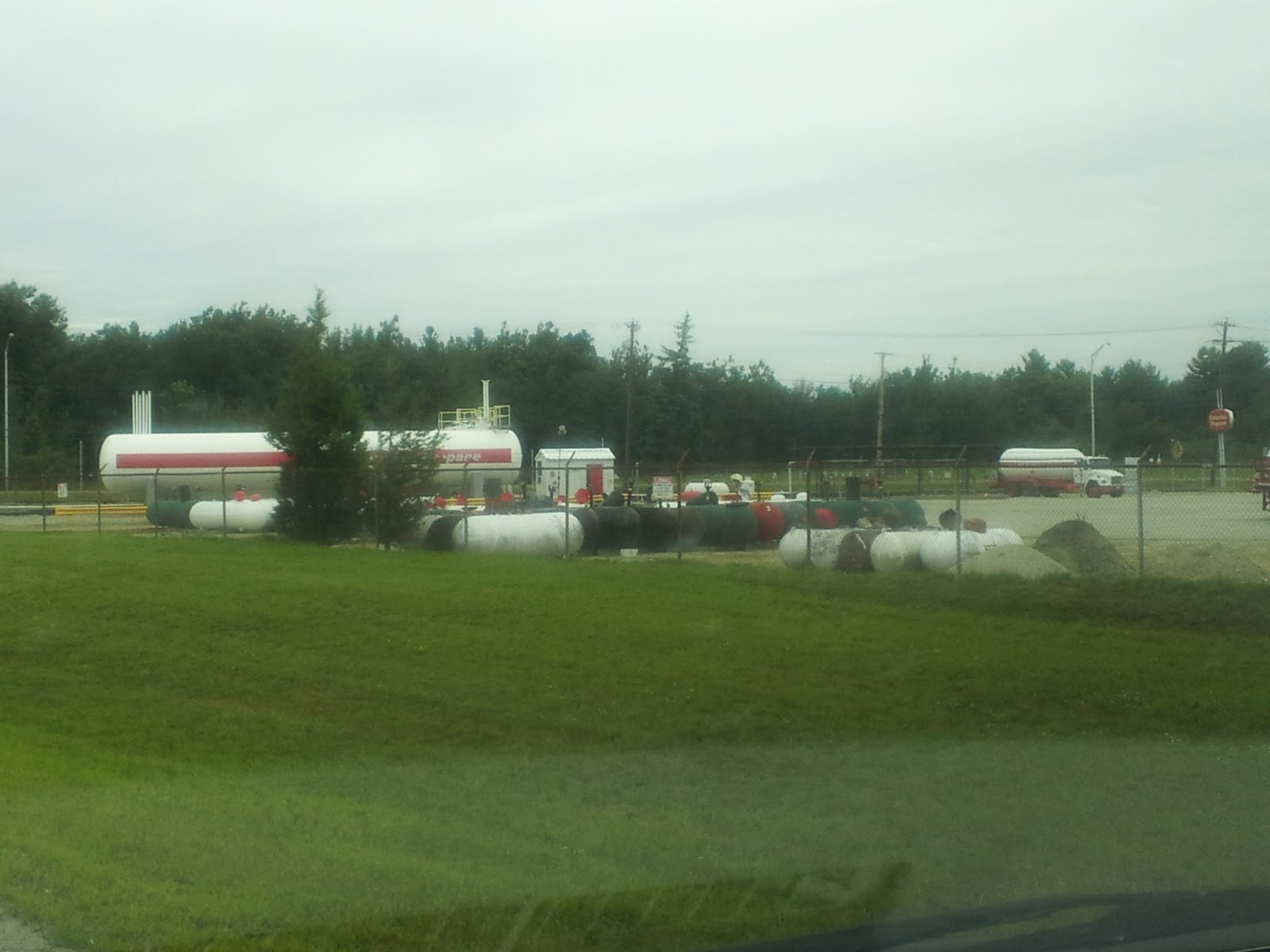
To make its way to New Hampshire, our propane molecule is then pumped across country in the Texas Eastern Transmission pipeline, known as TET, to distribution points in New York State. From there it is distributed to New England retailers in rail tanker cars or propane tanker trucks. Propane is then stored onsite at various propane retailers (see photo below) and from there it is transported by a smaller propane truck to be pumped into storage tanks at residences. Propane also makes its way into New England from East Coast petroleum refineries, natural gas operations in Pennsylvania, imports from Canada and, occasionally, waterborne imports from East and Gulf coast locations, or even Europe.


An illustrative diagram from the EIA, showing the flow of propane from well head to a home, is presented below.


There are two large propane storage terminals in New England. Both are located on the coast - one is in Providence, RI, and the other is in Newington, NH. Both are used to receive large shipments of waterborne propane but it is my understanding that these shipments are far and few in between at the moment as a result of low propane prices and the economics of waterborne propane shipments. In April this year, a plan to install a 22 million gallon propane storage facility in Searsport, Maine, was shelved due to local opposition and changing economic conditions in the propane business. The original intent of the project was to bolster propane storage for the State of Maine which was faced with a severe propane shortfall in the winter of 2007.

Let us now turn our attention to the matter of propane pricing. Presently propane is selling for $2.99/gallon for bulk residential delivery in NH but its price at the Mont Belvieu hub is $0.85/gallon. (Just last week, I filled my 5 gallon propane tank for my gas grill and it cost me $4/gallon.) I find these spreads between the commodity and retail prices very interesting, especially as we have to bear them. I want to understand how a product that costs less than $1/gallon in purified form at the main hub ends up costing us $4/gallon or higher. I find it useful to compare fossil fuel price spreads to those between crude oil and gasoline at the pump. Crude oil last week was about $106 per barrel (Brent pricing) and at 42 gallons per barrel, this calculates out to $2.53 per gallon of crude. Compare this to refined gasoline prices at the pump at $3.53 per gallon, which gives us a $1/gallon spread to cover refining, transportation, storage, taxes, marketing and a profit margin. Now I know this comparison of crude oil to refined gasoline at the pump is, at best, an approximation - as 1 gallon of crude does not necessarily lead to one gallon of gasoline but, for our purposes, it will suffice. The table below provides some spreads for hydrocarbon fuels and, even though these spreads are not exactly comparable, they provide a useful basis of comparison for the propane spread.

I have highlighted the propane ratio - which is on the low end at the moment. There are times, particularly in the high usage winter months, that this ratio will climb to 4.5 or as high as 5.
 
What are the reasons for these high spreads in propane prices? Why should propane cost more than 3.5 to 4.5 times its wholesale price at the hub - especially at a time when we are swimming in excess propane in the USA? In fact, we now have so much propane in the US as a result of the natural gas boom, that we are exporting large amounts of propane from the US.

It proved challenging to find someone in the NH propane industry to chat to me about these price issues. In every case, my calls to various propane dealers and even to the New England Propane Association went unanswered. I suppose one could generously assume that these folks were busy and simply did not have time to share with me the complexity of the propane business. Without an insider's understanding of the business, one is left with publically available information so here is what I know: 
 

  • The propane industry is an unregulated industry and, as such, does not come under the purvey of the Public Utilities Commission.
  • There are a large number of propane distributors in New Hampshire, ranging from small operations to larger ones.
  • The Consumer Protection and Antitrust Bureau of the NH Attorney General's office receives approximately 30 propane-related complaints per year.
  • The propane business is highly seasonal, with sales peaking in the winter months -see the figure below.
 
     
  • Propane dealers have to hold inventories of propane through the slow summer months and they have to bear the carrying costs associated with their propane inventories throughout the year.
  • There are various different types of retail propane contracts out there. Some dealers will lease a storage tank to a customer. However, should a customer want to change suppliers, they have to pay significant costs to have the leased tank emptied and removed. These high changeover costs can essentially "lock in" a customer, making it difficult to change propane suppliers. A better solution would seem to be to own one's own tank but this requires a big upfront investment and some propane dealers only service their own tanks. It would seem that propane users would be beholden to a regional group of propane dealers and some propane users have complained of being held "captive" by their propane dealers.
  • Generally, there is little transparency in the propane market as it is not a regulated commodity like natural gas or electricity. As such, residential propane users are subject to the whims and fluctuations in their regional distribution markets which may make getting competitive prices challenging.
  • Propane prices fluctuate considerably from dealer to dealer and direct comparisons are sometimes difficult. Sometimes quoted prices are "all-in" delivery prices and sometimes they exclude delivery charges and other miscellaneous charges that get tacked on, such as hazardous material handling fees. According to the folks at the NH Office of Energy Planning, OEP, the spread of propane prices can sometime vary as much as a $1/gallon across the State.

As I worked to understand more about the propane industry, local pricing started to perplex me, especially when I compared it to national pricing averages. Consider the following facts:
  • Propane production has increased in the past few years due to the natural gas boom – see the chart below.
  • Due to the surfeit of propane, prices are down. In fact, propane prices used to be tightly coupled to those of crude oil. For many years, the commodity price of propane, the Mont Belvieu hub price, would run at between 60 and 70% of that of crude oil. Now the relationship has broken down and propane commodity prices are averaging about 40% of crude oil prices. This is reflected in lower propane commodity prices during the past two years as shown in the figure below. Since the peak in June 2008, propane prices are now 54% lower. In fact, commodity propane prices are close to what they were in 2004.

And what of retail propane prices in NH? Retail propane prices are collected by a survey conducted by the NH OEP and are passed along to the Energy Information Agency, EIA, where the data are made available for access. However, pricing data are only collected during the heating season, from October to March, which is the reason for the annual gaps in the NH retail propane price data I have presented in the chart below.

As can be seen, we in NH seem to have been subjected to a steady increase in the price of propane since 2004 and prices this past heating season were 226%(!) higher than those in 2004. It is interesting - and puzzling at the same time - to try to understand why long-term retail propane pricing has not reflected longer term changes in the underlying commodity prices. As I have noted earlier in this blog, the residential propane business is a very seasonal one and the challenge for propane dealers is that the bulk of retail propane sales are made in the winter months. However, they seem to be able to compensate for this by generally pushing prices higher during each heating season.

Even though I write from a NH perspective, the reader should appreciate that NH is not being singled out regarding residential propane prices: similar variations in residential propane prices have been observed throughout the US. But, here in NH propane consumers feel them more acutely as NH residential propane prices are, on average, 19% higher than the national average. That 19% average is perhaps reflective of the fact that we are pretty far down the propane distribution chain and it takes a lot to get that propane from Mont Belvieu, Texas, all the way to NH. It should be noted that I determined the 19% figure by averaging the retail prices for the individual heating seasons for the US and for NH and then calculated the ratio of the NH average heating season retail prices to those of the overall US numbers. In the figure below you can see the results of these calculations. The premium of NH propane prices to those of the US average fluctuates from year to year around the 1.19 average line but it is rather notable that the premium associated with NH retail propane this past 2012/2013 heating season is way above the average and NH propane cost 30% more than the US average. This clearly shows that NH propane consumers are not benefitting from lower commodity prices. While the US is now awash in propane and is exporting it, propane users in NH would seem to be subject to the whims of an unregulated propane market.

There is clearly much I do not fully understand about pricing issues in the retail propane market but, when compared to other fossil fuel sources, it is certainly lacking in transparency. The retail propane market is like crossing muddy waters* - one looks down and wonders what lies below the surface. Perhaps the readers of this blog might know more.

Regardless, the data clearly indicate that propane premiums in NH are presently excessive, compared to historical averages, and it will be interesting to see if they come back into line during the next heating season. For propane consumers in NH, it could be an expensive experiment.

Until next time, fill up your propane tank to the brim during the summer and remember to turn the lights off when you leave the room.

Mike Mooiman
Franklin Pierce University

mooimanm@franklinpierce.edu
8/16/13


(Crossing Muddy Waters* - A John Hiatt tune from a 2000 album with the same name. John Hiatt has always been one of my favorite singer songwriters and has been covered by dozens of artists including Bonnie Raitt, Bob Dylan, Keith Urban, Iggy Pop, etc. etc. He is worth discovering if you don't know his music. Enjoy Crossing Muddy Waters.)

Click on this link to receive email notifications for Energy in New Hampshire updates